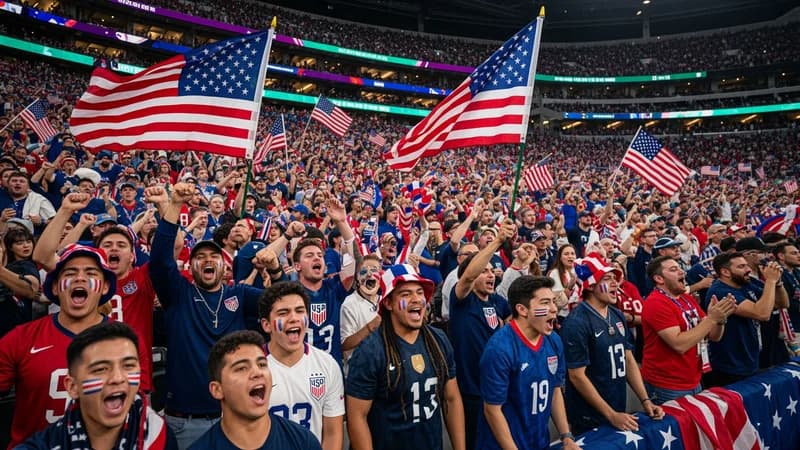
The United States hosts 78 of the 104 matches at the 2026 World Cup. That is more matches in one country than at any World Cup since the format expansion. The USMNT, short for the United States Men's National Team, will play every match in front of a home crowd, in stadiums where the team has played dozens of qualification and friendly matches over the past two cycles. Mauricio Pochettino, named head coach in September 2024, inherits the deepest player pool in the history of the United States Soccer Federation, the body that runs the men's and women's national teams.
The question is whether deep pool plus home advantage produces the result US Soccer has been chasing for thirty years: a quarter-final or further.
What the squad actually looks like
The current USMNT core was built between 2018 and 2023, and is now in its peak years. Christian Pulisic of AC Milan is 27 in June 2026 and scored 17 goals in all competitions for Milan in 2024-25, his best club return. Tyler Adams (Bournemouth) anchors the midfield. Weston McKennie (Juventus) provides box-to-box energy. Yunus Musah (AC Milan) gives technical depth. Folarin Balogun (Monaco) is the established central forward, with Josh Sargent (Norwich) as the alternative.
The defence is led by Antonee Robinson at left back (Fulham, named to the Professional Footballers' Association (PFA) Team of the Season 2024-25), Sergiño Dest at right back (PSV), and a centre-back partnership of Chris Richards (Crystal Palace) and Tim Ream (Charlotte FC). Goalkeeper is Matt Turner (currently Lyon) with Patrick Schulte of Columbus Crew as the second-choice option from Major League Soccer (MLS).
Compared to the 2022 squad in Qatar, the spine is older, more experienced and almost entirely playing in top-five European leagues. The 2022 squad averaged 25.2 years of age. The 2026 squad averages 27.1 years. That is the difference between a team in its development phase and a team in its prime window.
What Pochettino brings
Mauricio Pochettino was named USMNT head coach in September 2024 on a contract that runs through the 2026 cycle. His appointment was a deliberate break from the federation's previous model of promoting from within. Pochettino has Premier League and Champions League experience (Tottenham 2014-19, Paris Saint-Germain 2021-22, Chelsea 2023-24) and a tactical reputation built on pressing and possession.
His first competitive games in charge produced a clean win over Panama and a 1-1 draw with Mexico in the September 2024 international window. The 2025 friendly against Paraguay (a 2-2 draw) was the test of how the side handled a tournament-style opponent. Pochettino used a 4-3-3 with high pressing and asymmetric full-backs that the players seemed to take to.
The shift in style from Gregg Berhalter is real. Berhalter built around a 4-2-3-1 with deep-lying midfielders. Pochettino plays a higher line with more aggressive pressing triggers. The risk is that the press exposes the centre-backs against quality opposition. The opportunity is that the United States can dominate possession against weaker teams in the group stage and reach the knockouts with momentum.
The 1994 precedent
The last time the USA hosted a World Cup, in 1994, the team reached the Round of 16. That was the federation's best result for a generation. The team beat Colombia 2-1 (the match that included the Andrés Escobar own goal) and lost to Brazil 1-0 in the Round of 16. Bora Milutinović was the head coach. The squad included Tony Meola, Alexi Lalas and Eric Wynalda.
The 1994 squad had no players in top-five European leagues and trained together for months before the tournament. The 2026 squad has 18 of the 23 likely starters in top European leagues and convenes for international windows only. The two squads are not comparable. The 1994 standard, however, is the floor not the ceiling. Anything less than a Round of 16 in 2026 would be a serious failure.
The path through Group D
The official draw placed the United States in Group D alongside Paraguay and two other opponents. The opening match is on 12 June at SoFi Stadium in Los Angeles, against an as-yet-undrawn opponent (the United States plays the second match of the tournament's opening day, after Mexico's opener).
Group D is one of the more open groups in the 2026 draw. Paraguay finished sixth in CONMEBOL qualifying and is a tactically organised side capable of frustrating better opposition. Beyond Paraguay, the matchups depend on the final two teams in the group. The United States should win the group on paper. Failing to do so would mean a tougher Round of 32 draw.
The realistic ceiling
The deepest run in USMNT history was the quarter-finals at the 1930 World Cup in Uruguay, an era when the field was 13 teams and the Americans played one match to advance. In modern terms, the USA has never been past the Round of 16. Reaching the quarter-finals in 2026 would tie the all-time best.
That target is in reach. The 2026 bracket structure gives the USA a Round of 32 match against a third-place finisher (achievable), then a Round of 16 against a likely European or South American group winner (much harder). Pochettino's brief from US Soccer is to win the Round of 16. A semi-final would be a generational achievement.
What home advantage actually buys
Of the 22 men's World Cups played, the host has reached at least the semi-finals fourteen times. The reasons are well-documented: home crowds drive marginal officiating decisions, the visiting teams carry the jet-lag and travel burden, and the host squad sleeps in its own beds for the most demanding part of the cycle.
Two recent host nations missed the cut: South Africa in 2010 and Qatar in 2022, both eliminated in the group stage. The United States is unlikely to be the third exception. The squad is too experienced and the supporting infrastructure is too well-prepared. The realistic question is whether the USMNT plays its best football for seven matches in a row, which is what a quarter-final run requires.
For the full schedule of every USMNT match, including kickoff times in your local zone, see our match schedule. For travel logistics around the host cities, the host city guide covers airports, hotel pricing and stadium transit for every venue the team will play at.