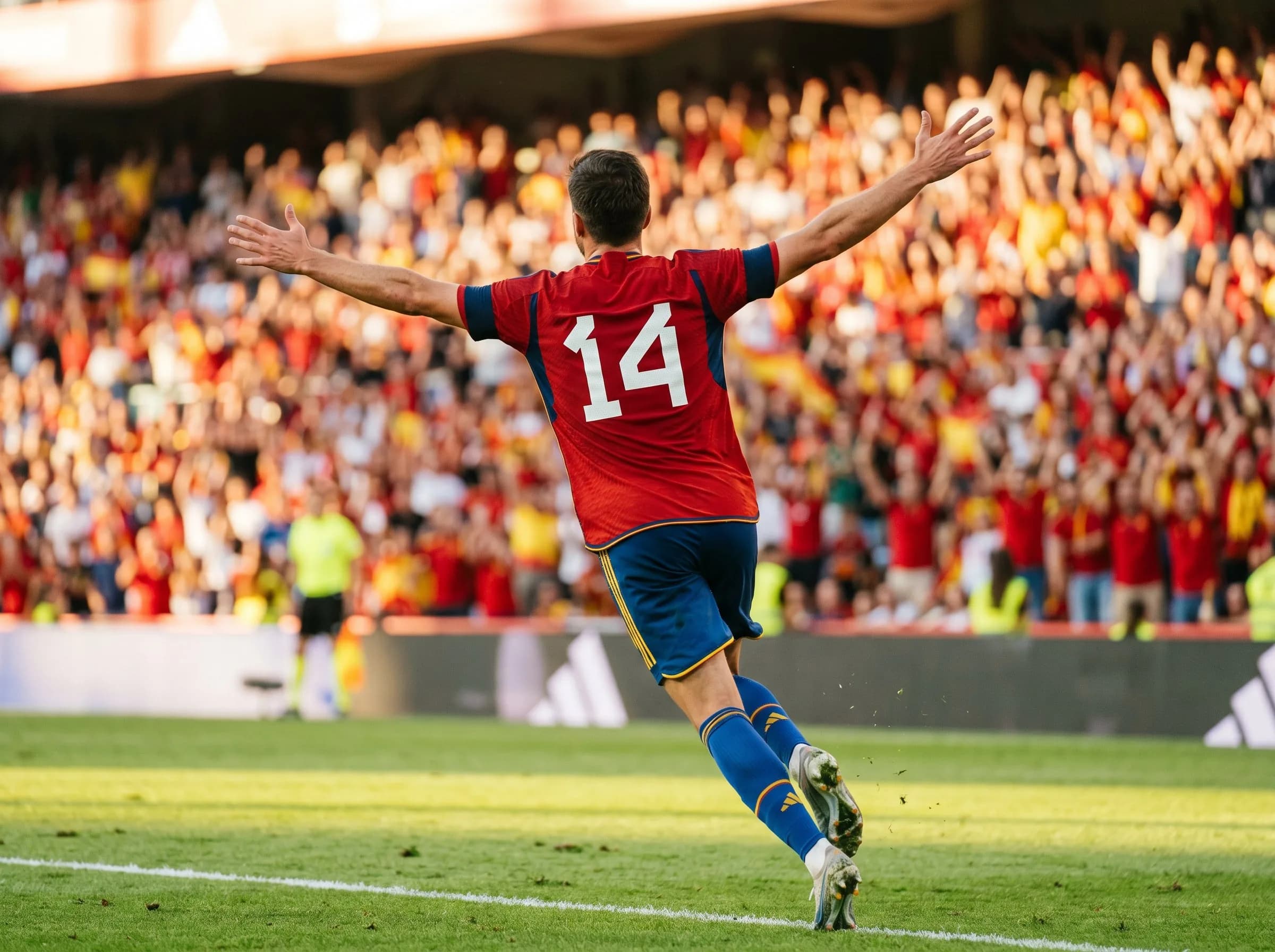
Spain won Euro 2024 with a team that almost no one had picked as favourites at the start of the tournament. They beat England 2-1 in the final at the Olympiastadion in Berlin. Lamine Yamal was 16 years old and named Young Player of the Tournament. Rodri won the Ballon d'Or, the annual award for the world's best men's footballer, in October that year. Spain enter the 2026 World Cup as the reigning European champions, with what the Spanish press is now calling the most talented under-25 generation in the country's football history.
The 2010 World Cup win in South Africa is the obvious historical reference point. The Tiki-taka era (a possession-heavy style based on short, quick passes that Spain perfected in the late 2000s) of Andrés Iniesta, Xavi Hernández and David Villa took Spain to one World Cup and two European Championships in five years. The current group is technically gifted in the same way, but plays a more direct, vertical version of possession football.
The Yamal generation
Lamine Yamal made his Spain debut in September 2023 at age 16. He scored against Croatia in his second start. By Euro 2024 he was a starter. By the end of 2024-25 he was a Ballon d'Or candidate. He turns 19 in July 2026, two days before the World Cup final. If Spain reaches the final, Yamal will play it as an 18-year-old.
The supporting cast is similarly young. Pedri of Barcelona is 23 in June 2026. Nico Williams of Athletic Bilbao is 23. Fermín López, also Barcelona, is 22. Gavi, when fit, is 21. The defensive line includes Pau Cubarsí, an 18-year-old centre-back who started for Spain at Euro 2024.
Older heads provide ballast. Rodri at 29 is the world's best defensive midfielder and the engine that lets Spain commit numbers forward. Aymeric Laporte and Robin Le Normand handle centre-back duties. Unai Simón is the established goalkeeper.
Luis de la Fuente's tactical break
Luis de la Fuente was promoted from Spain's under-21 setup in December 2022, after Luis Enrique's exit following Qatar 2022. Spain had been knocked out of three consecutive World Cups in the Round of 16 (2014), Round of 16 (2018) and Round of 16 (2022) playing variations on the slow possession style that had powered the 2010 win.
De la Fuente's brief was simple to understand if not to execute: stop being predictable. His Spain plays with the same possession dominance (averaging 65 percent across Euro 2024) but transitions faster, gets the ball wide earlier, and crosses more frequently. The wide channels are the weapon. Yamal on the right and Williams on the left both attack 1v1 (in football shorthand, taking on a single defender in an isolated duel). Spain create more open-play crosses than any major European nation in 2024-25 international fixtures, according to FBref (a publicly accessible football statistics database) data.
The defensive numbers are equally important. Spain conceded four goals across seven Euro 2024 matches, three of them in the knockout rounds. The block is high but disciplined.
How this team compares to 2010
Spain's 2010 squad averaged 26.8 years across the starting XI. The 2026 likely starting XI averages 24.4 years. That is the youngest starting line-up of any team that has been priced shorter than 8/1 to win a World Cup since 1990. Brazil's 2002 winners averaged 27.4. France's 2018 winners averaged 26.0. Argentina's 2022 winners averaged 28.6.
A young squad has historically struggled with the third week of a tournament, when accumulated fatigue and emotional load become the limiting factor. The 1958 Brazil squad, the youngest World Cup winners in modern history, averaged 23.6 across the team. They beat that fatigue threshold by playing a superior style. Spain in 2026 has the same opportunity.
For the contrast, the 1998 France team that won at home averaged 26.7 and famously played its best football in the final week. The 2026 Spain team will have to do the same, but starting from a younger base.
Group I and the bracket
Spain was placed in Group I for 2026, alongside Norway and two others. The Norway match is the key fixture. Norway qualified for its first World Cup since 1998. Erling Haaland will play his first World Cup against the team that knocked his country out of qualification for 2022. The narrative is set.
Win the group and Spain plays a Round of 32 against a third-place finisher, a typically winnable match. The Round of 16 is where the bracket gets serious. The cross-group seeding routes Spain into a likely match against the winner or runner-up of Group J or K. The quarter-finals could pit Spain against France, Germany or Brazil.
Spain's record in penalty shoot-outs is a hidden vulnerability. The team has lost three of its last five major-tournament shoot-outs. Euro 2008 (quarter-final against Italy) and Euro 2012 (final against Italy) were the wins. Euro 2020 (semi-final against Italy), the 2018 World Cup Round of 16 (against Russia), and the 2014 group-stage exit had penalty implications that did not break in Spain's favour. The 2026 squad has not played a competitive penalty shoot-out under De la Fuente. If Spain reaches the knockout phase, the rotation of penalty takers is something to watch.
The realistic ceiling
Spain are one of five teams the bookmakers price below 8/1 to win the trophy. The others are France, Argentina, Brazil and England. That tier reflects a real consensus among scouts and analysts: Spain can win this World Cup.
The barriers are not in the squad. They are in the bracket and in injuries. Yamal's club workload at Barcelona has been heavy. Rodri's knee has held up since his anterior cruciate ligament (ACL) injury in late 2024. Williams has had hamstring issues. Spain need a clean injury cycle through May and June. They also need to avoid France or Brazil before the semi-finals.
If those things break right, the 2026 World Cup ends with a 19-year-old Lamine Yamal lifting the trophy, and Luis de la Fuente becomes the Spanish coach who built the second golden generation. The realistic ceiling is the trophy. The realistic floor is a quarter-final exit. There is very little between those two outcomes.
For Spain's full match schedule and per-fixture analysis, see our matches page. For squad details and tactical setup, the Spain team page carries the projected starting XI and full roster.