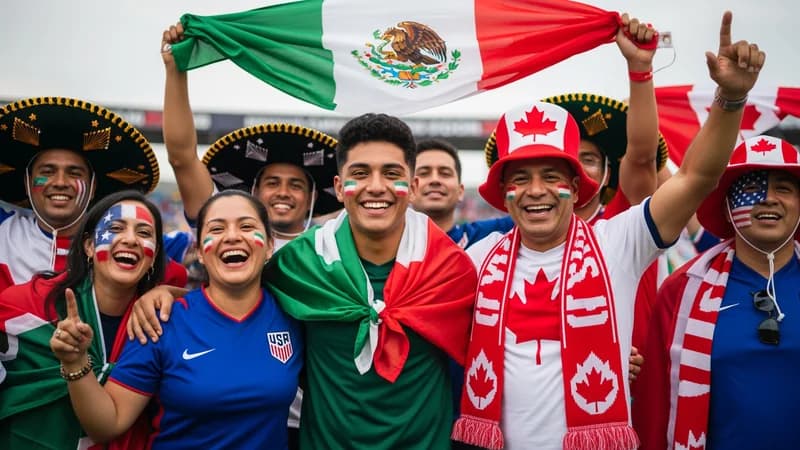
The 2026 World Cup is the first edition of the men's tournament hosted by three countries. A fan following one team through the group stage may travel from a match in Toronto to a match in Mexico City to a match in Atlanta within a single week. Each of the three host countries has a distinct cultural rule set, and the small differences are the ones that catch visitors out. This guide covers the practical customs you need to know in each: greetings, tipping, dress codes, language, queue etiquette and the small social rules that no government website teaches.
The pattern across all three is that the official tourism information understates the variation. The United States is not one cultural country but at least four (the Northeast, the South, the Midwest and the West). Canada has the English-French divide and the regional differences between Atlantic Canada, central Canada and the Pacific coast. Mexico is more linguistically uniform but with strong regional differences between the north (more US-influenced), the centre (the colonial capital) and the south (more indigenous influence). What follows is the most useful subset for a visiting World Cup fan.
Greetings and physical contact
In the United States, the standard greeting between unfamiliar adults is a handshake (firm, brief, with eye contact). A hug is reserved for friends and family. A kiss on the cheek is reserved for romantic partners and very close family. The handshake norm holds for both men and women.
In Canada, the same handshake norm applies in English-speaking provinces. In French-speaking Quebec, the standard greeting between adults who have been introduced is one kiss on each cheek (la bise), starting with the right cheek. The kiss is air-only, with no actual lip contact, and is reserved for established acquaintances rather than strangers.
In Mexico, the standard greeting between men is a handshake. Between women, or between a man and a woman, the standard greeting is one kiss on the right cheek (the same as Quebec). Hugs (abrazos) are common between men who know each other. Personal space in conversation is closer than in the US or Canada by 15 to 30 centimetres.
Tipping
Tipping rules are different in each country, and getting them wrong is the most common visitor mistake.
In the United States, tipping in restaurants is mandatory by social convention (though not legal requirement). The standard is 18 to 20 percent of the pre-tax bill at sit-down restaurants. Bartenders expect USD 1 to USD 2 per drink, or 18 to 20 percent of the tab. Taxi and rideshare drivers expect 15 to 20 percent. Hotel housekeeping expects USD 3 to USD 5 per day. Bag handlers expect USD 1 to USD 2 per bag. Tipping the driver of a tour bus or city tour is USD 5 to USD 10 per person. Tipping less than the standard is read as a complaint about service. Tipping nothing is read as deliberate rudeness.
In Canada, tipping rules mirror the US. The standard is 15 to 18 percent at sit-down restaurants (slightly lower than the US, but credit card terminals often default to 18 percent). Bartenders, taxis and rideshares: same as US. Hotel staff: same as US.
In Mexico, tipping is more variable. The standard at sit-down restaurants is 10 to 15 percent of the pre-tax bill. Bartenders expect MXN 20 to MXN 50 per drink, or 10 to 15 percent of the tab. Taxi drivers do not expect a tip on a metered fare but appreciate rounding up. Bag handlers at hotels expect MXN 20 to MXN 50 per bag. Hotel housekeeping expects MXN 50 to MXN 100 per day. The exception worth knowing is the gas station attendant, who expects MXN 10 to MXN 20 for filling your tank (a service that does not exist at most US or Canadian stations). Mexican law also allows certain venues to add a 10 percent service charge to the bill, in which case additional tipping is optional.
Dress codes
The default for matches at all 16 host venues is casual. Replica national team kits are the most common attire, followed by casual streetwear. There is no formal dress code at any stadium. Sunglasses, hats and bag-rules apply but no clothing-style rules.
For dinners and bars in the host cities, dress codes vary. The United States is mostly casual, with the exception of upscale restaurants in New York City, Miami and Los Angeles where business-casual or smart-casual is expected. Canada is similar to the US. Mexico City and Monterrey expect smart-casual at upscale dinners and at the better cocktail bars. Trainers (sneakers) are accepted everywhere except a small number of upscale Mexico City venues. Shorts are accepted in casual settings but are read as informal in restaurants in Mexico City and Monterrey.
Language
In the United States, English is the dominant language across all host cities. Spanish is widely spoken in Texas, California, Arizona and Miami, and many service workers in those cities are bilingual. A handful of phrases in Spanish (Hola, gracias, por favor, donde esta el bano) is appreciated in Spanish-influenced areas but English will work everywhere.
In Canada, English is dominant in all host cities. Toronto and Vancouver are both English-first. Montreal (not a host city but the natural travel option from Toronto) is French-first, where a few phrases of French (Bonjour, merci, s'il vous plait, ou sont les toilettes) is socially expected even from English-speaking visitors. The federal government operates bilingually but provincial services in Ontario and British Columbia are mostly English-only.
In Mexico, Spanish is dominant. Tourist-facing service workers in Mexico City, Cancun and other tourism centres often speak some English, but ordinary restaurants, taxis and shops will operate in Spanish. A basic Spanish vocabulary (numbers, greetings, food terms, transport phrases) makes the trip dramatically easier. The standard tourist-Spanish phrasebook covers 90 percent of practical situations.
Queue etiquette
Queueing rules are surprisingly different across the three countries.
In the United Kingdom (not a host country, but a useful reference for visitors from Europe), queue jumping is a serious social offence. The same is true in Canada, where queue jumping at any service venue draws audible disapproval from the rest of the queue. The United States is similar, with queue jumping treated as poor manners. Mexico is more flexible: queues exist but are less rigid, and a polite verbal "permiso" (excuse me) is sometimes used to skip ahead in informal settings. In the United States and Canada, do not assume the same flexibility applies.
Stadium queues for entry, food and toilets at all 16 host venues are first-come, first-served and rigorously enforced. The fair-play norm is universal at sporting events across the three countries.
Smoking and cannabis
Cigarette smoking is restricted in indoor public spaces in all three countries. Outdoor smoking is allowed in the United States and Mexico but discouraged in most areas of Canada (Ontario and British Columbia ban smoking within 9 metres of a building entrance).
Cannabis is legal recreationally in Canada and in 24 US states (including California, Washington, New York, Massachusetts, Colorado and others). It is illegal recreationally in Mexico, though personal possession of small amounts is decriminalised. Importantly, cannabis cannot legally cross the US-Canada or US-Mexico border in either direction, even between states or provinces where it is legal at the destination. Crossing the border with cannabis on your person, in your luggage, or even with traces in your bloodstream from a recent use, can result in entry refusal and a permanent ban from the destination country.
Tipping and the bill: the dollar question
In all three countries, the bill at a restaurant arrives only when requested. In the United States and Canada, asking for the bill ("Could we get the check, please?" in the US, "Could we get the bill, please?" in Canada) is standard. In Mexico, ask for "la cuenta, por favor". The bill will arrive within five minutes. Paying by card is accepted at almost every restaurant in all three countries. Cash is preferred at smaller venues in Mexico (and is the only option at street food stalls).
Splitting the bill among a group is simple in all three countries. In the United States and Canada, restaurants will split the bill across multiple cards on request. In Mexico, splitting is also accepted but the system is older and slower at smaller venues, where one person paying and the others reimbursing in cash is faster.